
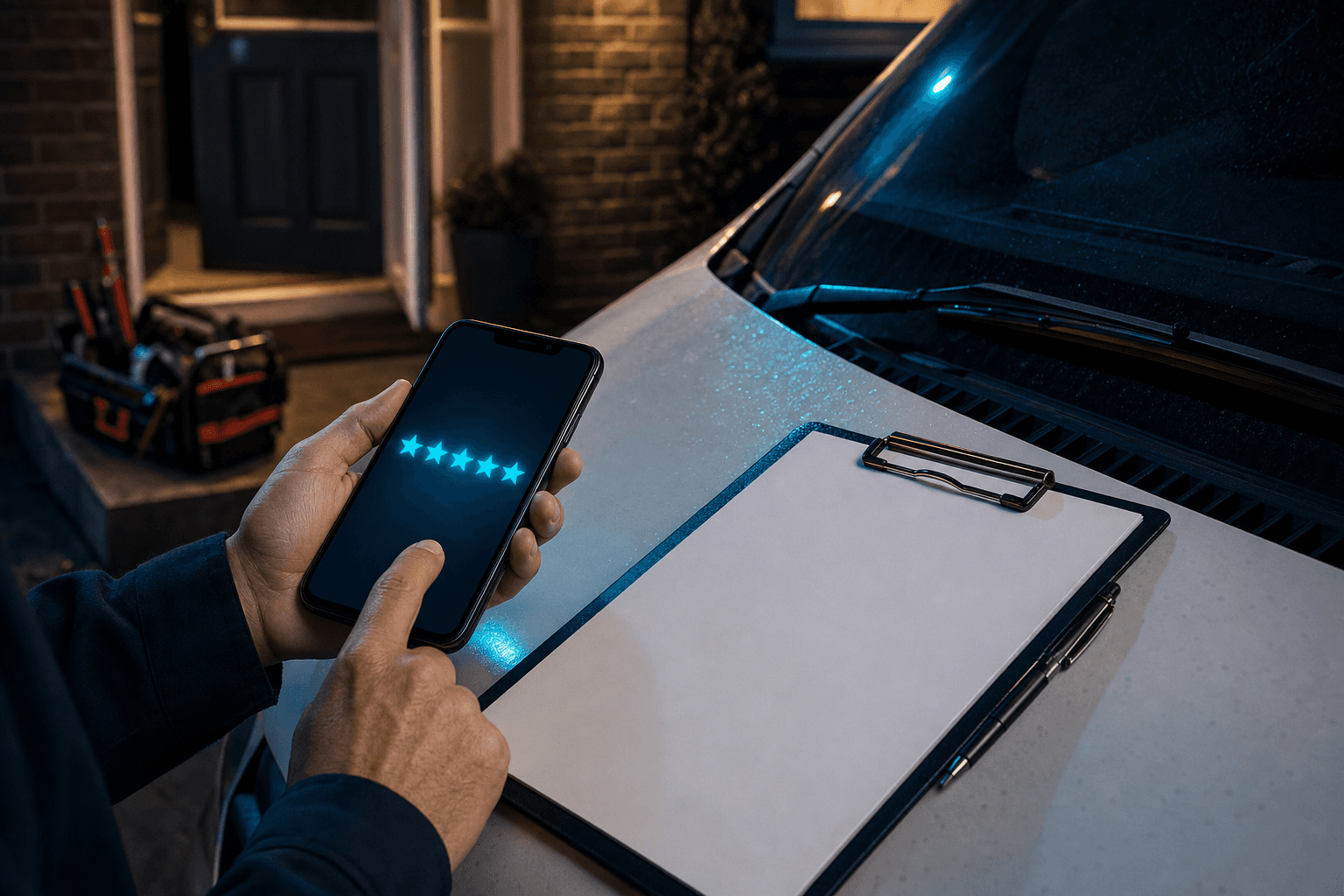
Most businesses don't have a review problem. They have an asking problem.
If you've got 11 Google reviews and the firm two streets over has 180, that gap almost never comes down to who does better work. One of them asks every customer, every time, using a system. The other asks when they happen to remember.
Reviews are unusual in that they pay you twice. They feed the signals Google uses to decide which local businesses to show, and they do the closing work on the person comparing three options at nine o'clock on a Tuesday night.
So the goal isn't "get more reviews" as a vague ambition. It's a small, repeatable pipeline that turns finished work into public proof, stays inside Google's rules, and handles the occasional one-star without anyone panicking.
That last part is where most advice trails off. We'll cover it properly.
Why Google reviews do two jobs at once
Google's own guidance on improving your local ranking names three ingredients that decide who shows up in local results. Relevance, distance and prominence. Review count and review score sit squarely inside prominence, alongside things like links and mentions elsewhere on the web.
That's the ranking half, and it's the half everyone talks about.
The conversion half matters more. When your business does appear in the map pack (the block of three local businesses with a map that Google shows above the normal blue links), the star rating and review count are the only differences a searcher can see at a glance. Everything else about you is invisible at that moment.
Four stars from 96 people beats five stars from three people, almost every time. A perfect score from a handful of reviewers reads as "friends and family" to anyone paying attention.
Reviews are one input among several, and they won't rescue a profile that's missing categories, service areas or photos. If you haven't done that groundwork yet, start with our guide to local SEO for small businesses and come back to this.
Google Business Profile
The free listing that controls how your business appears in Google Search and Google Maps, including your reviews, hours, photos and service areas. It's what people used to call Google My Business.
What you'll need before you ask a single customer
None of this needs software. It needs about forty minutes of setup and one person who owns it.
Your setup list
- A verified Google Business Profile. If the listing isn't verified, you can't collect or reply to reviews.
- Your short review link. One URL that opens the review box directly, so nobody has to hunt for your listing.
- A named owner. One person accountable for asks going out and replies going up. Shared responsibility means nobody does it.
- Somewhere to log the ask. A CRM field or a spreadsheet column. You're tracking asks, not just reviews.
- A printed asset. A QR code on the invoice, the receipt, the van, the counter or the leave-behind card.
The five-step review pipeline
The sequence below is the whole thing. It works for a plumber, a dental practice, a law firm or a garage, with only the wording changing.

Get your review link and make it easy to hand over
Sign in to your Google Business Profile, either through the profile manager or directly on your listing in Google Search. There's an "Ask for reviews" option that produces a short link which opens the review box straight away.
Copy that link once and store it where your team can grab it in two seconds. A note pinned in your phone, a text-replacement shortcut, a line in the CRM template.
Then turn the same link into a QR code and print it. Invoice footer, receipt, appointment card, the back of the counter menu, a sticker inside the van door. Any free QR generator will do the job.
Pick the moment, because timing beats wording
There's a short window after you've delivered where the customer feels relief or delight. Ask inside that window and you'll get a review. Ask three weeks later and you'll get silence.
For a trade or a home service, that's the moment the job is signed off and they can see the result. For a clinic or a salon, it's at the desk before they leave. For a professional services firm, it's the day the deal completes or the case closes, not the day the invoice clears.
For anything with a delivery, wait until the thing has actually arrived and been used once.
The wrong moment is right after you've raised a difficult invoice, chased a payment, or rescheduled them.
Ask out loud first
A verbal ask from the person who did the work converts far better than any automated message, because it carries a small social obligation that an email can't.
It also has to be genuinely low pressure, or you'll poison the relationship over a review.
Here's the whole script.
"Glad that's sorted for you. Reviews are honestly how people find us, so if you've got a minute I'll text you a link. No problem at all if you'd rather not."
Two things are doing the work there. You've explained why it matters to you, and you've given them a clean way to say no.
Follow up in writing within 24 hours
The verbal ask sets it up. The written message with the link is what actually gets it written, because nobody types out a review while standing in their hallway.
SMS beats email for consumer and home services by a wide margin. Email works better for B2B, where the recipient lives in their inbox and may need to check with a colleague first.
Send it the same day, or the next morning at the latest. One reminder three or four days later if nothing arrives, then stop. Two nudges is persistence and three is harassment.
Make it a weekly habit, not a campaign
Review drives are the reason so many profiles show a suspicious clump of reviews in one month and nothing for the following year. Google's systems notice unnatural bursts, and so do customers scrolling your dates.
Steady wins. Five reviews a month, every month, builds a profile that looks alive and keeps your review velocity (the rate at which new reviews arrive) consistent.
Put a fifteen-minute slot in the diary every Friday. Count how many customers you served, how many were asked, and how many reviews landed. The gap between the first two numbers is where your growth is hiding.
Track asks, not just reviews. If 40 customers were served and 9 were asked, the problem isn't your review link or your wording. It's that 31 people never got the question.
The rules most businesses break without realising
This is where well-meaning owners get themselves in trouble, usually on the advice of someone selling them a tablet for the front desk.
Two practices are off the table.
Review gating
Filtering customers before you ask, so only the ones you already know are happy get pointed at Google. Usually done with a survey that sends high scorers to your review link and low scorers to a private complaints form.
Gating is a violation of Google's user-contributed content policies, and it's the default setting on a lot of reputation tools. If a system asks "how did we do?" and only shows the Google link to people who answer positively, that's gating, however politely it's worded.
Incentives are the second one. Offering money off, a free coffee, a prize draw entry or any other reward in exchange for a review breaks Google's policies on fake engagement, and it can get individual reviews removed or the whole profile flagged.
In the UK there's a legal layer on top. The Digital Markets, Competition and Consumers Act 2024 makes commissioning fake reviews, and publishing reviews without disclosing that they were incentivised, a banned practice that the Competition and Markets Authority can enforce against directly.
Policy-safe asks vs the ones that get profiles flagged
| Feature | Policy-safe | Risky or banned |
|---|---|---|
| Who you ask | Every customer, whatever you expect them to say | Only the ones you've screened as happy |
| What you offer | Nothing at all | Discount, free item, prize draw entry |
| How you word it | Honest feedback, whatever the rating | Please leave us a 5-star review |
| Front-desk tablet | Opens your review link for anyone | Survey that routes low scores to a private form |
| Who writes them | Real customers only | Staff, family, or a bought review package |
The good news is that compliant asking outperforms gating anyway. Asking everyone gives you volume, and volume is what the ranking signal rewards. A few three-star reviews with a calm reply underneath make the five-star ones believable.
Review request templates that actually get replies
Use these as starting points and rewrite them so they sound like you. The tell of a templated ask is a message that no human would say out loud.
SMS, home or consumer service
Hi Sarah, thanks for having us out today. Reviews are how most people find us, so if you've got a spare minute here's the link [LINK]. Either way, thanks for choosing us. Dave at Fenton Plumbing.
Email, B2B or professional services
Subject: One quick favour
Hi James, good to get that over the line last week. If you felt the process went well, a short Google review would genuinely help us. It's the first thing prospective clients look at, and two lines is plenty [LINK]. No obligation whatsoever, and thanks again for your time.
The single reminder, three or four days later
Hi Sarah, just closing the loop in case my message got buried. The link's here if you get a moment [LINK]. Happy to leave it there if not.
Invoice or receipt footer, printed
Happy with the work? Scan to leave us a Google review. It takes a minute and it makes a real difference to a small local business.
Three details make a measurable difference across all of them. Use the customer's name, name the specific job so the message can't read as bulk-sent, and always include an explicit permission to decline.
Never suggest a rating. "Leave us a review" is fine. "Leave us a five-star review" is not.
How to respond to a bad Google review
First, the reassurance you probably need: one negative review among a healthy set does you almost no damage. Shoppers actively distrust flawless profiles, and many read the negatives specifically to see how the business behaves under pressure.
Your reply isn't for the reviewer. It's for the next 200 people who read it.

Wait a few hours before you write anything. Same-day is ideal, within 48 hours is fine, and the reply you draft while your blood is up is the one that gets screenshotted.
Then work through four moves in order.
- Thank them and acknowledge itUse their name, thank them for the feedback, and accept that their experience fell short. No defensiveness in the first sentence.
- Own the specific issueRestate what went wrong in plain language. Vagueness reads as a dodge, and specificity reads as a business that actually listened.
- Move it offline with a real personGive a name, a direct number or email, and an invitation to sort it out properly. Public threads never resolve, they just get longer.
- Say what's changedOne sentence on the fix. This is the line that converts the sceptical reader, because it shows you learn from problems.
When the complaint is fair
Hi Mark, thank you for telling us, and I'm sorry. You were quoted a two-hour window and we arrived four hours late without calling you, which isn't acceptable. I'm Dan, the owner, and I'd like to put it right. You can reach me on 01234 567890 any time. We've since changed how we handle running late, so customers get a call the moment a job overruns.
When they've got the facts wrong
Correct the record once, politely, without arguing.
Hi Priya, sorry your experience didn't match what you expected. Our records show the cancellation fee was in the booking confirmation you received, though I can see how it came as an unwelcome surprise on the day. I'd rather discuss it directly than here. I'm Kate, the practice manager, on [email protected].
When you don't think they're a customer
Reply neutrally, then flag it. Never accuse anyone publicly of faking it.
We can't find this booking in our records and we'd really like to understand what happened. If you contact us on 01234 567890 with your booking reference, we'll look into it straight away.
Google will remove reviews that break its content policies, including fake engagement, off-topic content and abuse. It won't remove a review for being negative, unfair or bad for business. Flag through your profile, expect it to take time, and get on with collecting new reviews in the meantime, because volume dilutes a single bad one faster than any appeal.
What good looks like after 90 days
Reviews compound slowly, then all at once. Nothing much appears to happen for six weeks, then you notice you're being chosen more often without a corresponding lift in traffic.
Watch four numbers rather than one. Total reviews, reviews added per month, percentage of reviews you've replied to, and calls or form fills coming from your Google profile.
That last one is the number that actually pays your wages. A profile with 60 reviews and consistent replies converts map-pack impressions into enquiries at a rate that surprises most owners the first time they measure it, which is why we treat reviews as a core part of how you generate more local leads online rather than a reputation side project.
- Copy your Google review link and save it as a phone shortcut
- Print a QR code on invoices, receipts or leave-behind cards
- Write your verbal ask script and share it with the team
- Set up the SMS and email templates in your CRM or phone
- Audit any review tool you use for gating behaviour
- Book fifteen minutes every Friday to count asks and reply to reviews
If you're doing all six of those and enquiries still aren't moving, the bottleneck is somewhere else in the funnel, and our rundown of lead generation strategies for small businesses is the better next read.
Common questions
How do I ask customers for a Google review?
Ask out loud at the moment the work is finished, then send your short review link by text or email the same day. Use their name, mention the specific job, and make it easy to decline.
One reminder after three or four days is plenty. The verbal ask is what makes the written message work, so don't skip straight to automation.
Can you offer discounts for reviews?
No. Offering a discount, a free item or a prize draw entry in exchange for a review breaks Google's policies on fake engagement, and the reviews can be removed or the profile flagged.
In the UK, publishing incentivised reviews without disclosure is also a banned commercial practice under the Digital Markets, Competition and Consumers Act 2024. Ask everyone, offer nothing.
How should I respond to a bad Google review?
Wait a few hours, then reply within 48 hours. Thank the reviewer, acknowledge that their experience fell short, restate the specific problem without excuses, give a named person and a direct contact to continue offline, and finish with one line on what you've changed.
Write it for the next hundred readers rather than the reviewer.
Can I get a fake or unfair Google review removed?
You can flag it, and Google removes reviews that breach its content policies, such as fake engagement, off-topic posts or abusive language. It won't remove a review simply because it's negative or you disagree with it.
Reply neutrally in public while you wait, and keep collecting new reviews. Volume dilutes a single outlier faster than an appeal resolves.
How many Google reviews do I need to rank in the map pack?
There's no threshold. Review count and score feed the prominence signal Google uses for local ranking, so what matters is being competitive with the other businesses showing up for your searches.
Check the profiles currently ranking for your main service and location, note their counts, and aim to close the gap steadily rather than in one burst.
Is it safe to use review request software?
Yes, as long as it doesn't gate. Automated SMS and email requests sent to every customer are fine and save real time.
What's not fine is any flow that surveys people first and only shows the Google link to those who answer positively. Check the default settings before you switch anything on, because filtering is a common out-of-the-box configuration.
Further reading
- Improve your local ranking on GoogleGoogle Business Profile Help
- Prohibited and restricted content for user contributionsGoogle Maps Contributed Content Policy
- Reply to Google reviewsGoogle Business Profile Help
- Digital Markets, Competition and Consumers Act 2024legislation.gov.uk

